 Add to Chrome
 Add to Firefox
 Add to Edge
LLM-based Embeddings: Attention Values Encode Sentence Semantics Better Than Hidden States
Feb 02, 2026
Sentence representations are foundational to many Natural Language Processing (NLP) applications. While recent methods leverage Large Language Models (LLMs) to derive sentence representations, most rely on final-layer hidden states, which are optimized for next-token prediction and thus often fail to capture global, sentence-level semantics. This paper introduces a novel perspective, demonstrating that attention value vectors capture sentence semantics more effectively than hidden states. We propose Value Aggregation (VA), a simple method that pools token values across multiple layers and token indices. In a training-free setting, VA outperforms other LLM-based embeddings, even matches or surpasses the ensemble-based MetaEOL. Furthermore, we demonstrate that when paired with suitable prompts, the layer attention outputs can be interpreted as aligned weighted value vectors. Specifically, the attention scores of the last token function as the weights, while the output projection matrix ($W_O$) aligns these weighted value vectors with the common space of the LLM residual stream. This refined method, termed Aligned Weighted VA (AlignedWVA), achieves state-of-the-art performance among training-free LLM-based embeddings, outperforming the high-cost MetaEOL by a substantial margin. Finally, we highlight the potential of obtaining strong LLM embedding models through fine-tuning Value Aggregation.

Differentiable Fuzzy $\mathcal{ALC}$: A Neural-Symbolic Representation Language for Symbol Grounding
Dec 01, 2022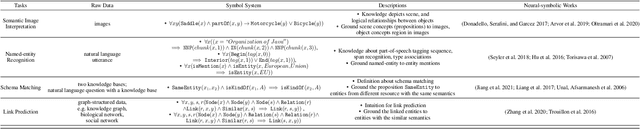
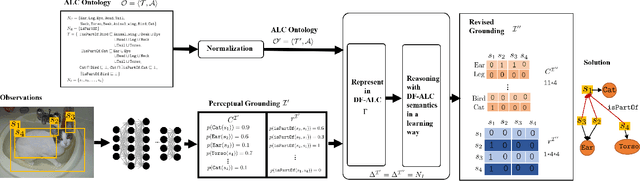
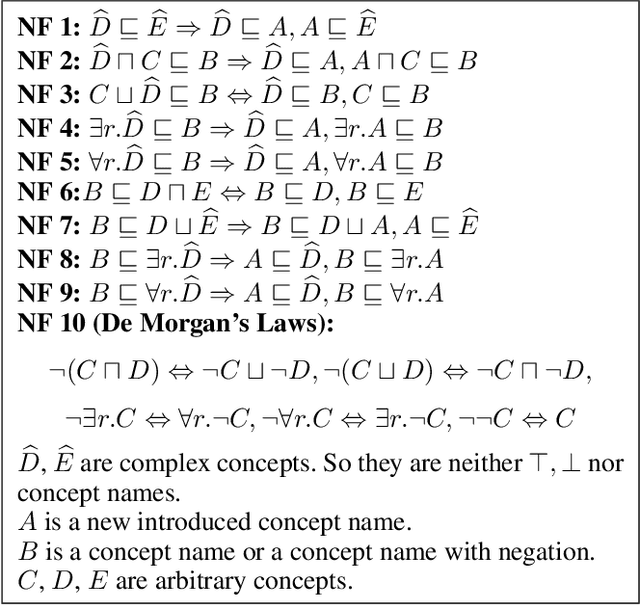
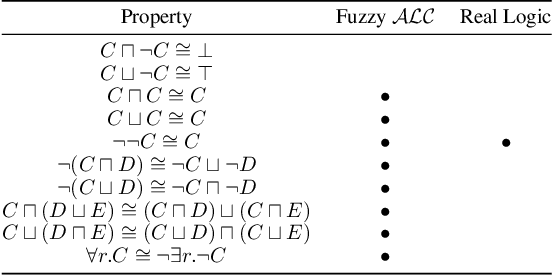
Neural-symbolic computing aims at integrating robust neural learning and sound symbolic reasoning into a single framework, so as to leverage the complementary strengths of both of these, seemingly unrelated (maybe even contradictory) AI paradigms. The central challenge in neural-symbolic computing is to unify the formulation of neural learning and symbolic reasoning into a single framework with common semantics, that is, to seek a joint representation between a neural model and a logical theory that can support the basic grounding learned by the neural model and also stick to the semantics of the logical theory. In this paper, we propose differentiable fuzzy $\mathcal{ALC}$ (DF-$\mathcal{ALC}$) for this role, as a neural-symbolic representation language with the desired semantics. DF-$\mathcal{ALC}$ unifies the description logic $\mathcal{ALC}$ and neural models for symbol grounding; in particular, it infuses an $\mathcal{ALC}$ knowledge base into neural models through differentiable concept and role embeddings. We define a hierarchical loss to the constraint that the grounding learned by neural models must be semantically consistent with $\mathcal{ALC}$ knowledge bases. And we find that capturing the semantics in grounding solely by maximizing satisfiability cannot revise grounding rationally. We further define a rule-based loss for DF adapting to symbol grounding problems. The experiment results show that DF-$\mathcal{ALC}$ with rule-based loss can improve the performance of image object detectors in an unsupervised learning way, even in low-resource situations.